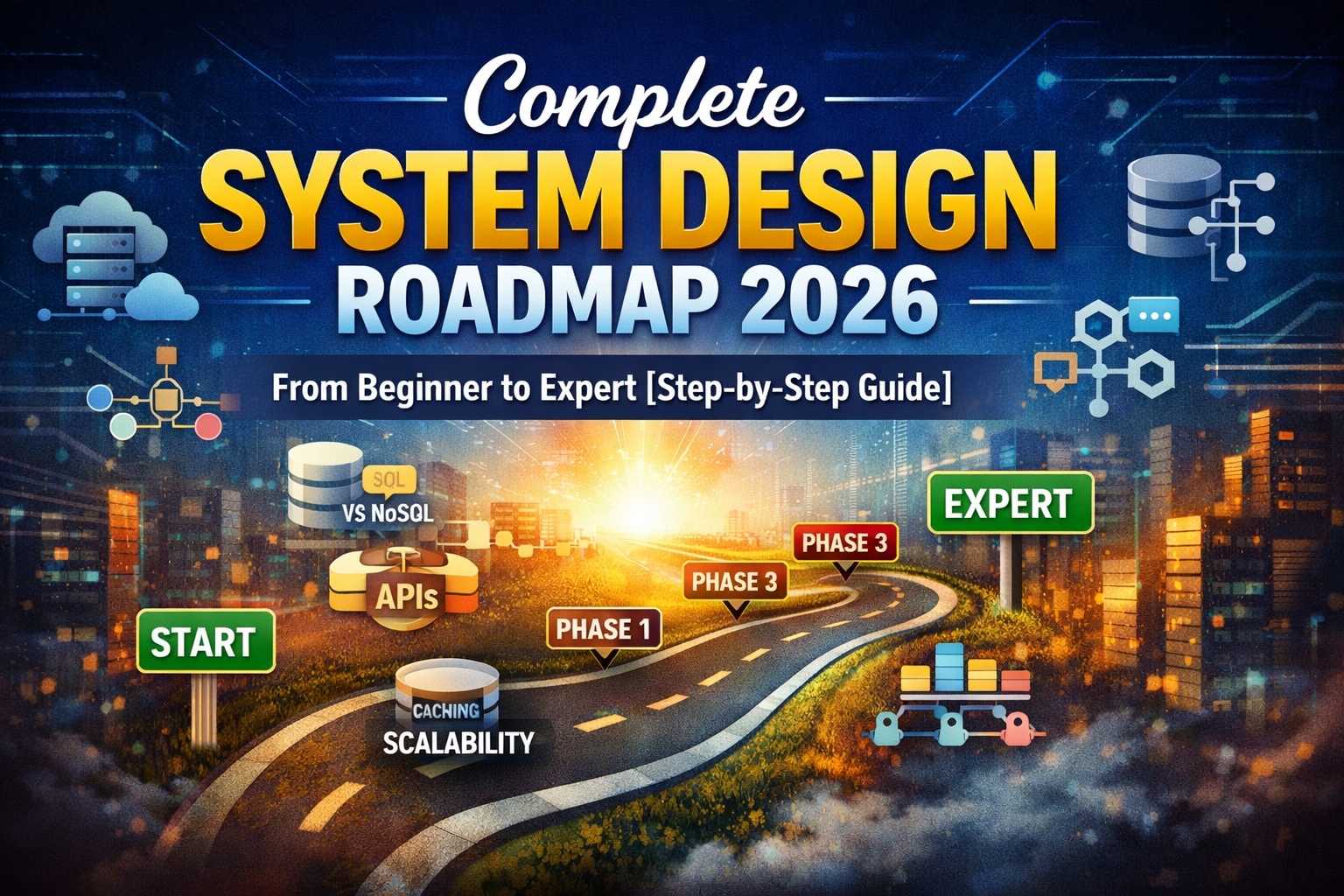
Master system design in 2026. Learn scalability, distributed systems, and FAANG interview preparation with this comprehensive roadmap.
Dev Kant Kumar
January 25, 2026
30-Second Key Takeaways
TL;DR
Quick digest before you dive deep
Master system design in 2026. Learn scalability, distributed systems, and FAANG interview preparation with this comprehensive roadmap.
A step-by-step system design roadmap for 2026.
Learn scalability, databases, APIs, caching, and distributed systems.
Dev Kant Kumar
January 25, 2026
12 min read
Career Strategy
"I'm going to be honest with you: AI is already replacing certain developer jobs. Junior positions are disappearing. Entry-level roles are harder to get."
The bootcamp graduate who could land a job in 2023? In 2026, they're competing with Claude, ChatGPT, and Copilot that code better, faster, and never ask for benefits.
But here's what nobody's telling you: While AI automates coding, there's a skill gap so massive that companies are throwing money at anyone who can solve it.
That skill? System Design.
GitHub's CPO calls it 'repository intelligence.' Microsoft Research says AI needs human architects. And the job market data is crystal clear: Architecture roles are growing while coding-only roles shrink.
You're right to be worried. But you might be worried about the wrong thing.
What is System Design? (Why It Matters in 2026)
Let’s address the elephant in the room. Job displacement is real.
Entry-level roles are being automated away.
90% of code is predicted to be AI-generated by the end of 2026.
Companies are maintaining output with smaller, leaner teams.
But there is a critical distinction to make. AI is excellent at tasks, but terrible at responsibilities.
What AI Can Do
Write boilerplate code instantly
Refactor existing functions
Generate unit tests
Find syntax errors
What AI Cannot Do
Understand business trade-offs
Take responsibility for crashes
Decide WHAT to build and WHY
Design for scale vs cost
Research Insight
"AI can write code. Sometimes good code. But technology work is not just coding. It is system design, trade-offs, constraints, and long-term thinking. Decisions made at the architecture level can define a product for years. No autocomplete can take responsibility for that."
Why System Design is the Career Moat
Think of the software industry as a hierarchy of skills. The bottom tier-basic CRUD, boilerplate, simple UI-is being eroded by automation. But the top tier is actually expanding.
1. AI Writes Code; Architects Decide What Code to Write
AI needs context. It needs specifications. It needs boundaries. Someone must define the "box" in which the AI operates. That person is the System Architect.
2. The Accountability Gap
When a distributed system fails at 3 AM because of a race condition in the database layer, you can't blame ChatGPT. Companies need humans to own the reliability, scalability, and security of their systems.
Real Market Data (2025-2026)
Architecture role mentions+200% growth
Junior coding role mentions-45% decline
System Design Fundamentals Every Engineer Must Know
Don't just "learn to code." Focus on high-leverage skills that AI complements but cannot replace.
Tier 1: Core System Design (Non-negotiable)
The fundamentals that never change.
Scalability PatternsDatabase Design (SQL vs NoSQL)Distributed Systems And API DesignCaching Strategies
Tier 2: AI-Era Additions (New & Critical)
How to architect FOR and WITH AI.
RAG ArchitectureVector DatabasesLLM Integration PatternsAgentic WorkflowsPrompt Engineering as Design
Your interactive checklist to becoming a System Architect
Total Duration: 12-18 months of focused learning
Click phases to expand
Phase 1: Foundation
2-3 months
0%
Complete
Phase 2: Core System Design Concepts
3-4 months
0%
Complete
Phase 3: Advanced Concepts
3-4 months
0%
Complete
Phase 4: Real-World System Design
3-4 months
0%
Complete
Phase 5: Architect Mindset
Ongoing
0%
Complete
📖 Recommended Resources
Books
Designing Data-Intensive Applications
System Design Interview Vol 1 & 2
Building Microservices
Clean Architecture
Websites & Blogs
ByteByteGo (Alex Xu)
High Scalability
Netflix Tech Blog
System Design Primer (GitHub)
The New Developer Career Path
The old path of "Learn to code → Junior Developer → Senior Developer" is broken. The new path looks different.
The Old Way
Learn Syntax
Build Simple Apps
Get Junior Job
Write Boilerplate
The New Way
Learn Fundamentals + System Design
Build Complex Systems (Not just features)
Demonstrate Architectural Thinking
Enter as Specialist/Mid-Level
"Recent graduates may not be ready to ship code on day one-but AI can. The experience gap is now an architecture gap."
Common System Design Interview Questions
Preparing for a system design interview? Whether you are targeting FAANG / MAANG or high-growth startups, you need to move beyond simple coding. Here is what real-world architectural challenges look like compared to AI-generated code.
Ex. 1
The URL Shortener
AI can code a URL shortener in 5 minutes. But...
❌ Can it handle 100M req/day?
❌ Can it design the sharding strategy?
❌ Can it optimize cost from $50k to $5k?
✅ That's System Design.
Ex. 2
The "Netflix" Problem
AI can build a video player component easily. But...
❌ Can it design the global CDN strategy?
❌ Can it handle multi-region failover?
❌ Can it optimize bandwidth costs?
✅ That's Architecture.
Addressing Common Objections
"But I'm just starting out..."
Start with system design THINKING. Build one complex system instead of ten simple features. Your portfolio should show decisions, not just code.
"This sounds too hard..."
It IS hard. That's exactly why it's valuable. AI makes easy things easier, which makes hard things necessary. The learning curve is your competitive advantage.
"Won't AI eventually do this too?"
Maybe in 10-20 years. But by the time AI can truly architect complex enterprise systems with accountability, you'll be 10 years ahead in your career.
The Action Plan
Your Next Steps
This Week
Pick ONE system design problem
Design it end-to-end (don't code yet)
Document decisions & trade-offs
This Month
Start Phase 1 of the Roadmap
Read "Designing Data-Intensive Applications"
Join system design communities
This Year
Complete the full roadmap
Build 3 complex systems
Write about your architecture decisions
Top 20 System Design Interview Questions
Highly searched questions for 2026 interviews. Master these to improve your interview performance.
Vertical Scaling (scaling up) means adding more power (CPU, RAM) to an existing server. Horizontal Scaling (scaling out) means adding more servers to the pool. Horizontal is preferred for distributed systems as it offers better fault tolerance and potentially infinite scale.
The CAP Theorem states that a distributed system can only guarantee two of three properties simultaneously: Consistency (every read receives the most recent write), Availability (every request receives a response), and Partition Tolerance (system continues to operate despite network failures). In reality, Partition Tolerance is non-negotiable, so you must choose between Consistency (CP) and Availability (AP).
Use SQL (Relational) for structured data, complex queries (joins), and when ACID compliance (transactions) is critical (e.g., banking). Use NoSQL for unstructured data, high write throughput, massive scalability needs, and flexible schemas (e.g., social media feeds, logs).
Load balancing distributes incoming network traffic across multiple servers to ensure no single server is overwhelmed. Common algorithms include Round Robin (distributed sequentially), Least Connections (sent to server with fewest active connections), and IP Hash (client IP determines the server).
Latency is the time it takes to process a single request (speed). Throughput is the number of requests a system can handle per second (capacity). A system can have high throughput but high latency (slow but handles many at once) or low latency but low throughput.
Sharding is a specific type of partitioning where data is distributed across multiple physical database servers (nodes) to spread load. Partitioning is a broader term that can also refer to splitting tables within a single database instance (e.g., by date).
A Content Delivery Network (CDN) is a geographically distributed group of servers that caches static content (images, CSS, JS, videos) closer to the user. It reduces latency, decreases server load, and improves user experience globally.
ACID stands for Atomicity (all or nothing transactions), Consistency (database remains in a valid state), Isolation (transactions don't interfere with each other), and Durability (saved data survives power loss). Key for financial and critical systems.
Consistent Hashing is a technique used in distributed systems (like caches or load balancers) to minimize reorganization results when nodes are added or removed. Unlike simple modulo hashing, only K/n keys need to be remapped, where K is keys and n is node count.
REST is the standard for public APIs, caching, and simple resource access. GraphQL prevents over-fetching/under-fetching data, allows clients to request exactly what they need, and is great for complex front-ends with diverse data requirements.
Long Polling involves the client making a request and the server holding it open until data is available, then closing it (unidirectional). WebSockets provide a full-duplex, persistent communication channel over a single TCP connection, ideal for real-time chat or gaming.
Common strategies include: Cache-Aside (app checks cache first, then DB), Write-Through (write to cache and DB simultaneously), Write-Back (write to cache first, async to DB), and Write-Around (write directly to DB, bypass cache).
A Reverse Proxy sits in front of web servers and forwards client requests to them. It provides security, load balancing, SSL termination, and caching. Nginx is a popular example.
A SPOF is a part of a system that, if it fails, will stop the entire system from working. System design aims to eliminate SPOFs through redundancy (e.g., failover database replicas, multiple load balancers).
Rate limiting controls the number of requests a user/client can make in a given timeframe to prevent abuse (DDoS). Algorithms include Token Bucket, Leaky Bucket, Fixed Window Counter, and Sliding Window Log.
Monoliths are built as a single unified unit; easier to develop/deploy initially but hard to scale. Microservices break the app into small, independent services communicating via APIs; harder to manage but easier to scale and deploy independently.
Replication involves copying data from one database server to another. Master-Slave replication allows writes to Master and reads from Slaves (scaling reads). Master-Master allows writes to any node (higher availability but complex conflict resolution).
A Bloom Filter is a probabilistic data structure used to test whether an element is a member of a set. It is memory efficient and fast. It can tell you 'definitely not in set' or 'maybe in set', but never false negatives.
A consistency model used in distributed systems where, if no new updates are made to a given data item, eventually all accesses to that item will return the last updated value. It prioritizes high availability over immediate consistency (e.g., DNS, social feeds).
An API Gateway is a server that acts as a single entry point for a system. It handles request routing, composition, and protocol translation. It often provides cross-cutting concerns like authentication, monitoring, and rate limiting.
The Bottom Line
While AI automates execution, it amplifies the value of decision-making.
Developers who position themselves as decision-makers (architects) rather than executors (coders) will thrive.
Enjoyed this article?Leave a reaction
Tap multiple times to show love!
Featured Laptop DealLive Deal
1 / 7
Best Business & After-Sales (Under ₹50K)
4.4/ 5.0 (Amazon Verified)
HP 250R G10 Business Laptop (Intel 14th Gen Core 3-100U / 512GB NVMe SSD / 15.6" FHD IPS)
✓Intel Core 3-100U 14th Gen Processor (6 Cores, 8 Threads up to 4.7GHz)



💬 Discussion